Playful Approaches to Internal Family Systems
Oct 22 2026

Last week at the Internal Family Systems International conference, I went to a session called ‘Playful IFS Pathways: Integrating Play Therapy, Expressive Arts, and Internal Family Systems.’
During the session, presenters Natasha Varela and Stefani Misiph explained how they integrate play therapy and IFS in sessions with children and young people. It got me thinking about how I do similar work with adults…
My potted history: I started off working with kids and young people as a performer, workshop leader and playworker. My deep embodied understanding of the healing potential of play brought me to study for an MA in dramatherapy in my early 30s. I gradually transitioned to working with grown ups, but I kept play as the centre of my work. I later trained in IFS and Somatic IFS and these days I run workshops for adults, mixing together play, performance, dramatherapy and Somatic IFS.
In my experience, playful approaches to therapy can be very potent for adults. We may look like grown ups on the outside, but many of our inner parts are very young. Some of our parts may relish invitations to express themselves through play, in a way that they might not be able to express in more “grown up” therapy.
Natasha and Stefani shared four ways in which play and IFS can be therapeutically powerful for kids. Using their headings, I’d like to share with you some of the ways this can translate to working with adults, through exploring some of the things we do in my Play, Presence and Parts (PPP) weekend workshop.
1.) Play Facilitates Communication

Natasha and Stefani say: “Play helps parts speak and be heard”
In my PPP weekend, I offer artwork, embodiment and small objects to help people get to know their parts.
Through externalising their inner parts by representing them with an image on a page or an object, people are able to take a step back and gain perspective. Seeing their parts from the outside allows them to understand more about them and how their parts relate to each other.
Through embodying their parts, people are able to gain insight from the inside. Discovering how parts hold their bodies, how they move, how they breathe, how they sound… opens pathways to compassion and understanding.
We make the unconscious conscious, using creativity and play.
2.) Play Fosters Emotional Wellness

Natasha and Stefani say: “Play builds emotional awareness and regulation”
Through externalising their parts in playful ways, people can begin to unblend from their parts. ‘Unblending’ is an IFS term which means to find separation between you and your parts. This separation paradoxically allows you to build a deeper relationship with your parts.
You get to understand more about them and they begin to trust you to be in the driving seat of your own life. The aim of the game is not to kill off your parts, but to develop a more harmonious relationship with your whole system, where you get to make choices around which parts are getting to drive you around your life.
In PPP, we’re exploring the parts that hinder access to play and connection. Developing a relationship with these parts can help them to relax, which can allow more play and connection to flow into your life. In my book, that’s a direct route to emotional wellness!
3.) Play Enhances Social Relationships
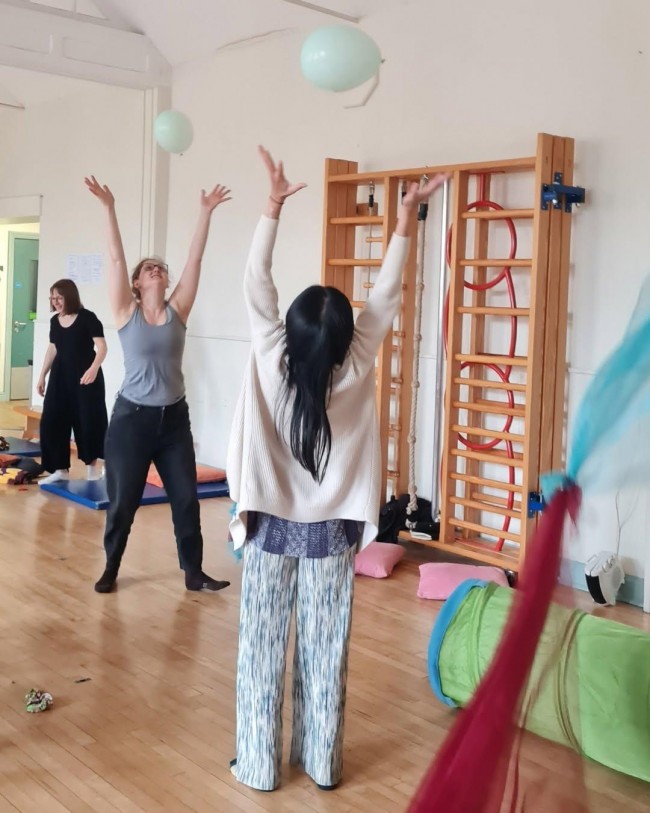
Natasha and Stefani say: “Play strengthens connection with self and others.”
During the PPP weekend, I offer a lot of different types of play to help the group build connection with themselves and others.
I offer mindful movement to help people connect with their bodies in curious, creative ways, before they connect with each other through playful movement. This shakes people out of their habitual patterns around movement and connection and opens them up to infinite possibility.
I offer sensory play, exploring objects through the senses to help people tap into a more curious and instinctive quality of play. After the play, I invite participants to reflect on the parts that tried to get involved with their play - the parts that had helpful suggestions and the parts that halted their play through criticism, judgement and shame.
PPP is a microcosm of the whole of life! The parts that tend to show up in the play will be familiar to the participants. The conditions of the workshop - explicitly stated boundaries, permission to adapt everything to suit you, lots of exercises to build trust, and a shared language of compassion and curiosity, are designed to help people to meet their parts in a different way.
The way we meet our parts is the key to transforming our relationship with our parts. This inner relationship directly impacts our outer relationships.
4.) Play Increases Personal Strengths

Natasha and Stefani say: “Play awakens resilience, courage, and transformation”
A big part of my work is helping adults to reconnect with their inner children. We all have protector parts (ie inner critics, inner managers, inner procrastinators, inner sugar fiends, etc) who took on their roles to keep us safe as kids. Meeting our protectors is the first stage of the process of freeing up our inner children. As we build trust with our protectors, they will eventually allow us to come into direct contact with the children they have been protecting all these years.
Once we’ve built trust with the inner children, then we can help them let go of the heavy burdens of “too much” and “not enough,” that they have been carrying throughout our lives. Unburdening can restore our inner children to their original nature, releasing them to be free, wild, playful, creative, sensitive, curious, silly, loud, quiet, happy, sad, angry, mediocre or whatever you weren’t allowed to be when you were a kid. These to me are the personal strengths worth cultivating!
I see so many glimmers of people’s inner children in PPP, it’s such a joy and a privilege. Oh how colourful the world would be if all of our inner children felt free to play!

If you want to try this out for yourself, I have two more Play Presence and Parts workshops this year, both in Bristol UK:
November 7 + 8 (sold out, waiting list in operation)
December 12 + 13 (places still available)
For more info check out this page.
Thanks to Natasha Varela and Stefani Misiph for their thought-provoking session at the IFSI conference.