Safe Enough To Play
Oct 05 2026
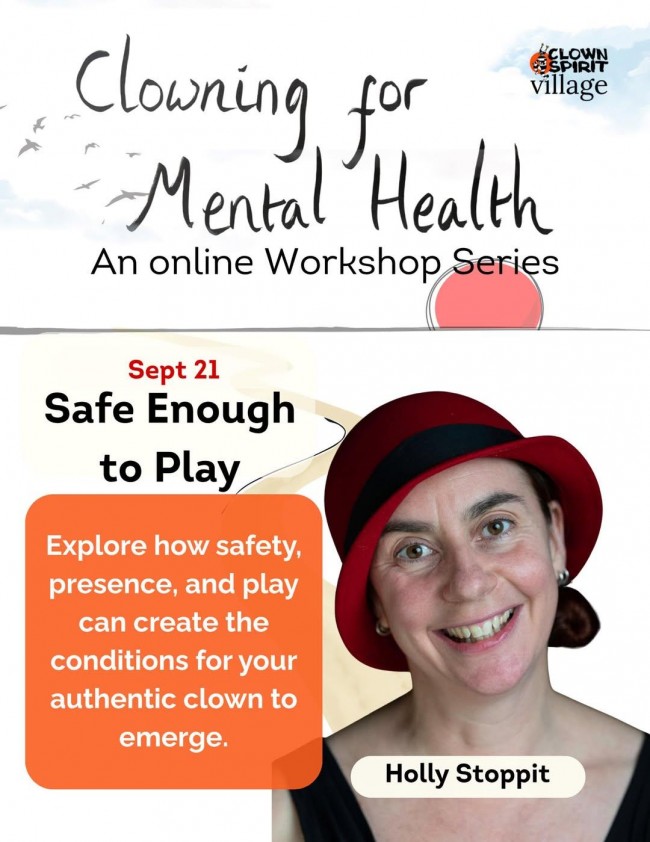
On September 21st 2026, I facilitated an online session as part of Clown Spirit’s ‘Clowning For Mental Health’ series. So much juicy thinking came out of the session, I want to share some of it with you, dear reader. Come join our thinking party and ponder along with us as we go.
My session was titled ‘Safe-Enough To Play,’ and was described like this:
Somatic IFS-trained dramatherapist and creator of Clown-o-Therapy, Holly Stoppit has spent two decades researching and practising the mental health benefits of clown skills training for adults. Her session recognises that authentic, risky and vibrant play cannot be demanded: it emerges naturally when people feel safe enough to be seen. Through somatic meditation, mindful movement, sensory play and shared reflection, participants explore what they personally need in order to feel safe enough to let their clown out.
Introduction
I began with a brief introduction and these basic boundaries, which I state at the beginning of all of my workshops:
- Everything is an invitation
- You can say yes, no or maybe to any of my offers
- You can adapt everything to suit your body, heart and mind
- Please take care of yourself and chose your own path through this session
These boundaries are designed to offer choice and autonomy in every moment, which are the conditions that I need in order to feel safe to play.
Q. What boundaries do you need to feel safe enough to play?
Exploring safety through somatic meditation
I led a grounding meditation, with opportunities to explore various anchors to safety. You could have a go at some of these now if you like. Notice how they make you feel:
1.) Find something in your vicinity that seems nourishing - maybe a plant, an animal, or an object that has some nourishing / safety-making qualities. Spend some time with it. Let yourself be nourished by it. Take in as much nourishment as you can.
2.) Play with your out-breath - breathe out a little more than you usually would. Trust the in-breath will take care of itself. Play with the qualities of your out-breath, make all sorts of sounds, try sighing, yawning, horsey lips, groaning, whatever.
3.) Offer yourself some soothing touch - maybe a little self-massage, maybe a tight self-hug, maybe a gentle stroke of your forehead or heart area. Try out and few things and see how they feel.
4.) Take yourself to somewhere nourishing in your imagination - maybe a space in nature - somewhere you already know, or maybe somewhere fantastical. Imagine yourself in that space - bring in all of your senses, imagine the temperature, sounds, smells, let your body really take it all in.
Q. How was that for you?
Safety means different things for different people and everyone has their own ways of accessing it. This activity was designed to help people explore a few techniques, but there are many other ways to find safety.
Q. How else might you access safety?
Safe, brave or dangerous?
Safety gets a bit of a bad press in clown circles - there tends to be more of a leaning towards, “push yourself out of your comfort zone,” or “break through your limitations.” This is all well and good, but having been a clown for 40 years and a clown teacher for 20 years, I have noticed that when we push ourselves too hard and too fast, we leave a lot of ourselves behind!
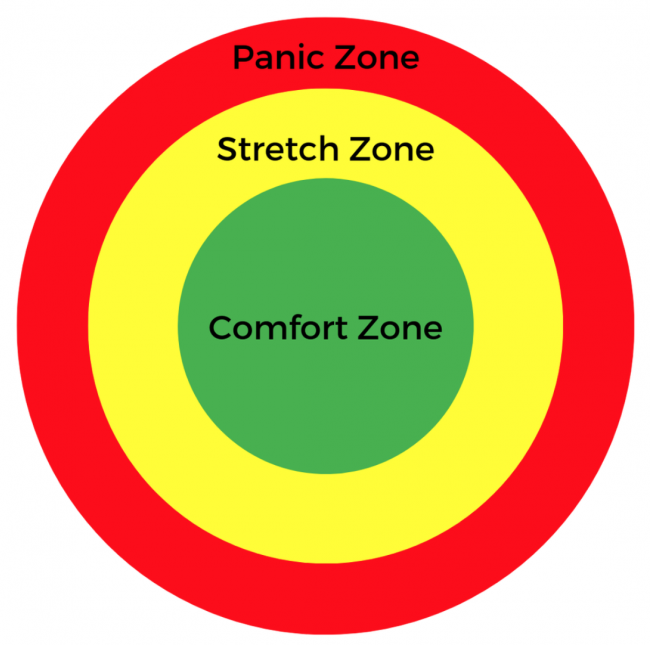
Tom Senninger came up with the ‘Learning Zone Model’ in 2000 (pic above), to map out the impact of safety on learning:
1.) Comfort Zone (Inner circle) later renamed safe space
In this zone, you’re comfortable, unchallenged and as safe as you can be. Some learning can take place here.
2.) Stretch Zone (Middle circle) later renamed brave space
In this zone there can be discomfort and challenge, but you are safe-enough to be able to meet it with curiosity. This is said to be the optimum space of learning and growth.
3.) Panic Zone (Outer circle) later renamed danger zone
In this zone, the level of discomfort and challenge tips over into danger and/or panic. Not much learning can take place here.
Q. Which zone are you in right now? What lets you know that?
Fight, flight, freeze
From what I’ve observed in myself and in the hundreds of clowns I’ve taught over the years, entering into play can push us into the Panic / Danger Zone very easily. I’ve seen it happen at every stage of clown training - sometimes just stepping into a workshop space can be enough for some people to get the inner emergency lights flashing, for others it’s speaking in a circle, doing warm up games, singing, dancing, or playing for an audience (it’s rare that people aren’t triggered by this bit!).
How this plays out in a workshop setting:
I’ve seen people get very big, loud, dominant, aggressive, not listening to others, not listening to me, sabotaging (could be seen as fight responses).
I’ve seen people run away, become very small and quiet, suddenly get ill, suddenly remember they have something else they really need to do (could be seen as flight responses).
I’ve seen people dissociate, get suddenly very sleepy or bored or floppy (could be seen as freeze responses).
We all have in-built survival strategies, commonly known as fight, flight, freeze (FFF). These ancient responses happen automatically, within 1/20th of a second of the amygdala part of the brain perceiving a threat.
When we’re in fight, flight freeze, we do whatever we have to, to stay alive; we punch the tiger in the face (fight), we run away from the tiger (flight) or we go floppy so the tiger is no longer interested in us as prey (freeze).
When we play from this place, our choices become limited. We lose connection with the full range of possibilities in ourselves, we lose connection with the full range of possibilities in others and we lose connection with our environment.
Q. Do you recognise any of those FFF behaviours in yourself? What are your favourite / go-to responses?
What are the threats to play?
Wondering what exactly poses as a threat to our play, I asked the group to brainstorm in the chat box and here’s what they came up with (I later sorted them into external and internal threats):
External threats
Judgement, criticism, anything that's like being scolded, being belittled, being misunderstood, being the only one playing, time constraints, the never ending to do list, weapons of mass destruction, feeling as if the teacher is setting you up to fail for their own ego, bullies, when the others are in competition, when the response snaps us back into the very efforts we are critiquing.
Internal threats
Judgement, imagined judgments, fear of failure, fear of 'doing it wrong,’ perfectionism, worry, historical experiences, losing myself and “going too far,” when I don’t feel like it, when I absolutely don’t believe, if I’ve not defined my performance goal, shame, taking myself too seriously, when I think I have too many things to do.
Q. What threatens your play?
My Methodology
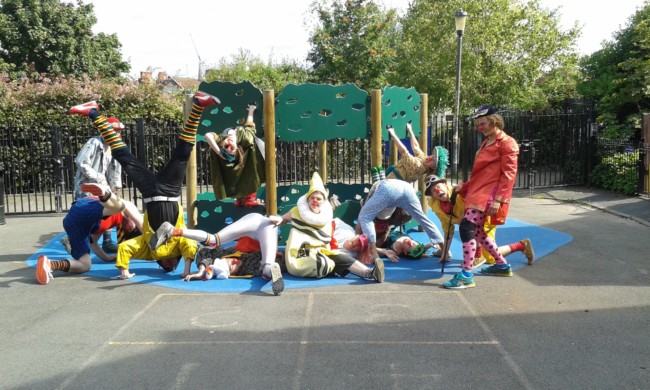
During my clown training, I use a lot of somatic meditation and psycho-education to help people notice how fight, flight freeze plays out in their body, heart and mind and what it makes them do. Noticing what’s happening, with curiosity and compassion, gives people an opportunity to meet themselves and their experiences in a different way, without the extra layer of judgement, criticism or shame which often accompanies FFF responses.
Throughout my training, I offer a lot of opportunities to explore and practice different anchors to safety (like the ones I shared above and many more) so that people have the tools and explicit permission to ground themselves in the eye of the storm, when they are triggered.
This all happens within clearly stated boundaries and with the support of the group as the container (I didn’t go into this too much during the session, but I tend to spend inordinate amounts of time on the early stages of group-bonding and trust-building, through play and sharing - this increases the safety which allows people to reveal their vulnerability later on.)
The aim of the game is not to be perfectly safe all the time, it’s about developing the awareness and tools that bring choice, so that you can move freely between comfort, stretch and panic.
Q. When have you felt safe-enough to play? What was helping you access that space of curiosity and wonder?
Experimenting with safety and danger through sensory play
After our discussion, I guided a sensory play session, inviting participants to notice when they felt safe and when they felt unsafe and to notice how that played out in their bodies, hearts and minds, in real time.
They started slowly in their own spaces, connecting with objects through their senses, before beginning to find simple little games to play with the objects.
I gradually increased the risk, inviting them to begin to find developments for their games and eventually find ways to connect with each other through the screen.
From time to time, I invited them to notice how safe or unsafe they felt - giving them options to either play with feelings of danger (eg if you’re nervous, be more nervous, if you’re stuck, be more stuck) or to take a pause and do something that helps you feel safer.
After the play, I invited them to journal about what they discovered, before inviting them to offer lines for two collective poems in the chat box. One called “When I feel unsafe to play” and one called “When I feel safe enough to play.” Their writing was so beautifully evocative, I decided to arrange their words into two poems to share back with them after the session.
Q. Notice how you feel as you read the two poems. Notice body sensations, emotions, thoughts…
When I feel unsafe to play
When I feel unsafe to play
Freedom is hiding
Permission is revoked
I want to run away,
Retreating behind
the plaster in the wall.
When I feel unsafe to play
I feel heavy,
Weight on my back, ache,
Weight is too heavy to move.
When I feel unsafe to play
I retreat into myself,
contracted into the body
I want to shrink and disappear.
When I feel unsafe to play
My heart beats like a drum,
I panic and worry I would fail,
and miss out on an opportunity.
My heart panics,
and sadness fills my bones.
When I feel unsafe to play
My head gets very loud.
My busy mind wants to stop me,
I am shocked to hear
my judgement of others.
When I feel unsafe to play
I get bigger to protect myself.
I feel the pressure to perform,
to be better than I am,
to push past my limits
and I don’t recognise myself.
When I feel unsafe to play
I take risks and fall on my sword,
Is it the doubt clogging my heart?
I bore myself,
Phone wins again.
When I feel unsafe to play
I say fukit!
It's exhilarating!
When I feel safe enough to play
When I feel safe enough to play
Firecrackers pop and swizzle,
I don’t try to prove or improve a thing.
Life is more fun!
When I feel safe enough to play
Curiosity absorbs me
I explore the world,
I feel alive.
When I feel safe enough to play
I’m already in it before I notice
My body says yes to my minds ideas
I can recognise what else is going on.
When I feel safe enough to play
I feel safe to take small risks.
I connect to others
and I serve my purpose.
When I feel safe enough to play
I have so much to give to the world
My heart is widely open
and the world invites me in.
When I feel safe enough to play
The child inside comes out,
Moving with fluidity and a smile
I feel light.
When I feel safe enough to play
My body feels energized
and I need to DANCE!
It is easier to play with others
and I make others feel better too.
When I feel safe enough to play
I don't feel separate anymore
and my heart feels joyful.
I am beautiful and I know.
When I feel safe enough to play
Everything is effortless,
My container can expand and contract
The amount that is needed.
Time changes.
When I feel safe enough to play
I am the best version of myself.
I let go of it all,
I am free!
Big thanks to the participants for jumping into the experiment with me.
Huge thanks to Clown Spirit for inviting me to create this session for their platform.
Other Holly-blogs that may be of interest:
- What gets in the way of play? - tales of my escapades at a Play Conference in Denmark earlier on this year.
- Clown Teachers Lab at Hawkwood- 6 clown teachers spent a week together, sharing their practice and wrangling with Big Questions around clown teaching.
- Playful Pauses - a bunch of 10 minute mindful play exercises you can try anytime, anywhere.
- How To Stay In The Unknown- a bumper Holly-blog, written after spending a year at a meditation retreat centre