Video: Clowning, Fooling and IFS at Clownvergence
Jul 17 2026
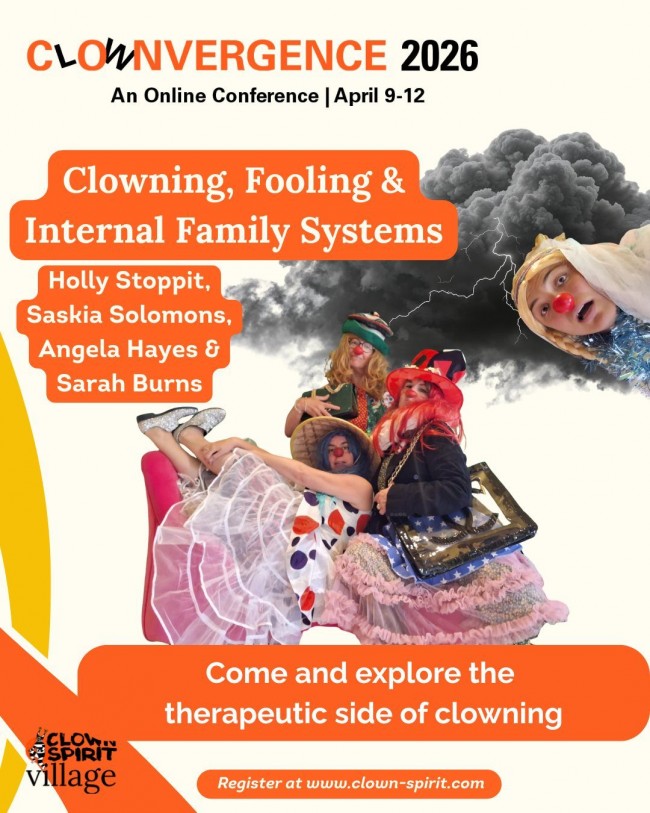
This session was presented at Clownvergence, an online Clown conference, on 10th April 2026.
You’ll find the video below, but first a note on this blog…
I have taken the transcript from the youtube video and tidied it up a bit, cutting out all the umms and uhhhs and repetitions. I have paraphrased some sections and added little extra bits for context, so that it can exist in the world as a piece of writing as well as a video.
Session description
Holly Stoppit, Sarah Burns, Saskia Solomons and Angela Hayes are a group of Internal Family Systems - trained clowns and fools. Internal Family Systems (IFS) is a therapeutic system that helps people get to know their internal family of parts - e.g. the inner critic, the inner child, the inner teenager, the inner sloth, the inner dreamer, the inner diva, etc…
We have been exploring the meeting point of clowning, fooling and IFS in a series of playful co-created labs since 2020 and we want to share some of our findings with you! Come and discover how IFS is helping us deepen our performance work and how clowning and fooling is helping us deepen our therapeutic work.
This session will be part-discussion, part experiential, with invitations for you to explore your inner parts along the way.
About the Speakers
Sarah Burns is an IFS Assistant Trainer and a Certified IFS therapist in private practice, based outside Bristol, UK. As a Dramatherapist, her passion is bringing creativity, embodiment and playfulness into therapy.
Saskia Solomons is a Lecoq-trained physical theatre performer and maker, an Internal Family Systems practitioner, storyteller, facilitator and trainee idiot on a mission to discover the most creative containers for healing and the most healingest environments for connective creative play - hurray!
Holly Stoppit grew up in the circus and has been clowning since the age of 6. She now works as a facilitator, educator, dramatherapist (MA), IFS therapist (level 2), clinical supervisor and creative consultant, offering playful, creative and reflective approaches to exploring the human condition.
Angela Hayes is a facilitator, community host, co-creator and coach, who found her way into clowning in mid- life. For over 3 years she has been living with a chronic illness, deepening her spirituality and playing with expressive arts and movement with mindful, slow, gentleness.
Here’s the video
You can also find it on youtube here.
Contents + time stamps
0.00 The arrival
6.00 Welcome to our research group
11.45 Sarah introduces IFS
25.00 Saskia offers an experiential - Parts Mapping
44.30 Holly offers context about our research lab
51.37 Sarah offers a vignette from our research lab
1.04.48Saskia offers a vignette from our research lab
1.20.30 Q&A and closing thoughts
The Arrival
We began the session by embodying some of our parts, in costume.
I arrived as Professor Patricia McNish, enthusiastically greeting the participants in mortar-board hat, glasses and a blazer.
Sarah was dressed as sequin-clad club singer, Candy. Wearing a huge curly wig, shades and lit-up tiara, Candy regaled the audience with tales of her deep and murky showbiz past.
Saskia arrived as Knackered Mum, late and flustered, still in her pyjamas, hair in a messy top-knot, still brushing her teeth.
Unfortunately Angela wasn't able to come to the session, but she was with us in spirit.
We spontaneously improvised together for a few minutes, whilst finding out where the participants were beaming in from.
Welcome to Our Research Group
Holly: There are actually four of us in this research group, but Angela isn't able to join us today. The four of us span four decades; Saskia is in their 30s, I'm in my 40s, Sarah is in her 50s, and Angela is in her 60s. We've been hanging out together since the pandemic, exploring how clowning, fooling, and Internal Family Systems (IFS) come together.
We started playing together on Zoom during the pandemic.
Then in 2024, we had our first play day. Three of us were in a studio in Bristol and one of us was beaming in via Zoom. We started to explore different ways to play with our parts, using artwork, dance/movement and embodiment. You can read more about what we did here.
We loved that day so much, that later that year, we decided to gather for a 4-day lab in a clown house in Nottingham. This was the first time the four of us were together in real life. This lab was mostly focussed on exploring our connection and feeling into the connection between Fooling and IFS, but there was a crazy, unscheduled clown explosion, thanks to the Clown House's abundant dressing up cupboard (that's the photo on the flyer above). We played, we reflected and we took it in turns to cook delicious banquets.
We liked it so much that in April 2025, we came together to do another 4-day lab at a retreat centre in Yorkshire. We’ll be sharing some snippets of what we discovered during this lab, later in this video.
A big part of our group ethos is radical inclusion. We co-create the conditions that allow us to show up just as we are. And in these conditions, we play, we reflect and we support each other to grow and to learn and to discover more about ourselves.
The discoveries that we've made through our research labs have informed our own personal development and our professional practice and it’s moving out into the world in many different exciting and wonderful ways.
An Overview of Internal Family Systems (IFS)
Sarah offered a very short presentation to introduce the basic concepts of IFS, starting with the question:
Have you ever felt pulled in two directions at the same time?
Sarah: Maybe there's one part of you that felt it had to do one particular thing and another part that almost pulled against it, wanting to do something else? For example, there might be a part of me that wants to eat something in the fridge and there might be another part of me that doesn't want me to.
IFS offers the premise that we all have parts, we each have an inner family, a bit like our own families. Some get on and some don't. But all parts have positive intentions. Each of these parts has their own thoughts, feelings, and roles.
Multiplicity is natural. We aren't meant to be one mono mind. Even as far back as the ancient Greeks, people have been talking about parts inside us. So it's not a sign that we're very seriously ill. It's a natural state and way of being.
Protector Parts
Parts do different things. One particular set of parts are called protectors. Protectors or protective parts are there to keep us safe. They might do things like push us to achieve, sometimes they criticise us, sometimes they will have us avoid certain situations, or they might even try and distract us, but always their intention is to look after us and to keep us safe.
Let's take the example of a critical mother who uses criticism as a strategy to help get the best for her child.
Protectors often get what they don't want. So if they're trying to avoid shame, they sometimes get shame.
Protectors are often young and they don't know another way of doing things.
Some examples of protective parts: the critic, the striving one, the people pleaser, the perfectionist.
Exiles
We have another group of parts which are called exiles. Like the real meaning of the word exile, they are banished from consciousness, banned from taking over, because often they carry a lot of pain, such as a trauma, grief, fear, shame, loneliness.
Our protectors are quite frightened of our exiles and do not want them to come into consciousness, because we might collapse. We might not be able to cope. We wouldn't be able to function in the world. So our protectors try and banish our exiles out of the way.
But the thing about exiles is that they want to come up. They want to come to the light. They want to be healed. And they don't want to be carrying whatever pain they're carrying. They want to offload it.
Self
We also have at the core of who we are this thing called a Self. The Self is not a part, it is our wholeness, our essence of who we actually are. So when we are connected to Self, we can listen to parts without being overwhelmed, we can build connection and trust and we can help them unburden their beliefs, beliefs such as like “I’m not good enough,” “I’m not lovable.” “I’m not worthy.” And when that happens, then we can come back to much more harmony and Self-leadership.
The Aims of IFS
The aims of IFS are:
▪ to free our parts from these extreme roles and beliefs (such as “I’m not good enough”)
▪ to build internal connection and relationship
▪ to create more harmony and balance, in which we can live our lives with more spontaneity and creativity
More than therapy
IFS is more than a therapy, it’s a psycho-spiritual model. For Sarah, it's a way of life. It can be applied to all of these things and more:
▪ Performance
▪ clowning
▪ education
▪ leadership
▪ business
▪ community
IFS is about building internal relationships, meeting our parts from Self.
Without Self-Leadership, our individual systems of parts are like Lord of The Flies. In Lord of the Flies, a group of children are left on a desert island and are doing all manner of awful things to each other, including trying to eat each other and bullying each other, acting out power and domination.
What we're aiming to do in IFS is to reparent all these lost little parts that need someone to lead. They need the parent to come home, because it's scary trying to manage on their own. When we offer Self to these parts, there can be more balance.
If we can build internal relationships, what happens on the inside, as we begin to know ourselves, we then can take to the outside, to the world, to the bigger Self. We can put that compassion, that love, our juiciness out there, to hopefully make a better world.
Question from a participant - how many parts might one person have?
Sarah: Lots and lots and lots. I'm still discovering more and more parts. Because our parts get frozen at different ages, they take on roles at different ages to protect. So, it is normal to have lots and lots and lots. Luckily we have a lifetime to get to know them!
Holly: I'm working with a client one-to-one. I do this process in the studio called Assembling Your Inner Cast. I invite people to embody their parts and they map them out on the ground. Each part has a little label on the ground so we can see them all, and see how they all relate to each other. There's one person that I'm working with who had 34 parts show up over the 2 days! That's the most out of all the clients that I’ve done this process with. But mostly we're working with 12 to 15 parts over 2-days.
Saskia: There's our biographical parts, but then there's also ancestral parts, you can go back and even forward in time. The systemic nature of IFS means that we are of course working with our own individual systems, but they ricochet out into the world, which is why I think it's such a marvellous model. We’re not seen as isolated as islands, we osmose.
Question from a participant - Would you say that whenever there is a shock or trauma in your history timeline that a part may arise as a way to manage that shock?
Holly: Yes, often more than one. Often you'll get a series of protectors all popping up in that moment going “I know how to deal with this.” “I know how to deal with this”. “I know how to deal with this.” And they all have completely different strategies to deal with the same trauma.
Sarah: Just to add, the motto of our protectors is “Never again, are we going to let that happen!”
Parts Mapping - An Experiential
Saskia offered an experiential to help you locate and explore your parts.
Saskia did a little demo and then invited participants to have a go.
If you want to try it out, you will need something to write on and a pen or pens.
To begin with, you are invited to draw a simple gingerbread human.
Saskia: Different parts of us can take lots and lots of different forms. You might notice that you have a thought, or you might notice a physical sensation somewhere in your body, or maybe an emotion or maybe a memory pops up.
I’m noticing a sort of fizziness in the centre part of my body.
So then I'm going to take my little gingerbread person and I'm going to grab a colour. This feels like it feels like a kind of orangey. So I'm just going to take my orange and I'm just going to put the energy onto the paper.
It's not about drawing it cleverly. If you have an amazing artist part that wants to draw it, fine. But it could be a dot, it could be a mark, it could be a scribble. It really doesn't matter what it looks like. It's about putting the energy and marking it on your gingerbread human body.
There are lots of people who can't feel their parts in their body, and it's really not an issue. If you don’t experience your parts that way, you might decide to mark your parts around your gingerbread human, or you might just decide to use a blank piece of paper. You do it your own way.
You might also notice that there are parts that feel like they're around you, rather than inside you. So, you might want to also feel into the space around your body.
Once you've marked your part down on your paper, then you just turn back inside again and you notice the next part.
I'm noticing that my heart is beating quite fast. So I'm going to take my red and I'm going to mark my red beating heart on my little guy.
It might be that it takes you some time to notice your parts. It might be that there's one part or it might be like there's a whole load of parts and that's okay. You can just take your time and notice what’s there.
Now it’s your turn!
- If you feel comfortable you can close your eyes. If you don't, maybe just drop your gaze and come into an internal space.
- It might feel good to just have a little sigh and drop your shoulders.
- It might feel good just to notice the ground underneath you.
- There's no right or wrong with this.
- Gently inviting your attention into your inside world.
- You might notice a sensation somewhere in your body. You might notice thoughts or an impulse.
- Maybe you're like, "I'm suddenly really hungry." Or “Oh, I need wee” or “I’m thinking about what I need to do later.” Maybe a memory pops up, or a fantasy. Just noticing whatever is there.
- And then, in your own time, whatever's there, marking it on the paper.
- At this point, I would invite you to avoid words. Words tend to channel us into different parts of our brain, and mark making really allows the energy of the part to be expressed onto the page. If of course you have a part that's like “What, no words?” then yes they can add some words at the end, that's absolutely welcome.
- There's really no right or wrong way of doing this. It's what feels right for you in your system.
- After you’ve done this for 5 or so minutes, have a look at your paper and notice if any parts come up in response to what you've done. It might be that there's a part that thinks it's a brilliant piece of artwork. There might be a part that's like “that looks rubbish.” There might be judgments or there might be delight or there might be anything in between. Mark down on the paper any responses you have to what you've done.
- If you want to add words as well, those words are welcome.
- As we move towards the end of this exercise, just check back in, in case there are any little parts in there that are like, "Wait, me, me, there's me here! Hang on!” Just taking another check inside.
- And then just letting your parts inside know, maybe just broadcasting this little message, that this isn't their only chance to be seen and known by you. That this is something you can continue doing, if it feels good, and that you can build a relationship with your parts and that they can be known by you.
- Just letting that land in your system and then just letting your parts know that we're going to draw this little exercise to a close
- It might feel good again to take another deep breath and just let yourself know that we're going to come back into this into external environment having been in an internal space.
All Parts Are Welcome
Saskia: A really important part of IFS is that every part that you noticed is absolutely welcome. It might be that you have parts that don't feel the same way and they're welcome too.
If this feels like something that you'd like to do, you can feel invited to continue doing this process throughout the rest of this session. You might notice that you have parts with feelings about what's being shared and you can absolutely note them down on your map.
Unblending
Saskia: I find this a very helpful way to, what's called in IFS “unblend,” which means that you separate from a part. When we are blended with a part, we see the world through the eyes of that part, we’re kind of in it. And when we do this mark-making process, we're able to separate ourselves and have more access to that Self energy, so that we can come into relationship, a somatic dialogue, with these parts of ourselves. It’s a really great way of beginning that relationship. There are lots of IFS folk that actually say that unblending - that separating process - is the first step to healing.
Our Group Culture
Holly: After we'd had a little squirm, stretch, shake and sound break, I explained... So, this is kind of how we work. We track ourselves. We track what's going on inside and we notice, “Ah, do you know what? We've been sitting and listening for ages. Let's just get into the body!” And so, we work as a kind of fluid, amorphous blob, where each of us takes turns to lead. Working from noticing parts, noticing impulses, noticing what's going on inside, and then each of us will propose something. That's how we construct our time together.
Fooling
Holly: Fooling is a beautiful form of solo improvisation. I have been studying it with Franki Anderson for 25 years. Franki is the master of the craft and the source. It's a beautiful form which I think saved my life. In my early 20s when I first started studying, I thought I was completely riddled with terrible demons and they wanted me dead. I was living with these horrible voices that were saying really awful things about me most of the time. I just thought that's who I was and I thought that's what I was going to have to deal with for the rest of my life. But when I found Franki, she taught me to separate from my parts, like Saskia was just talking about - unblending.
In Fooling, the performer walks onto an empty stage without a plan. You don't have a structure. You don't have a score. You just walk onto the stage and you take a moment to feel who's here. As soon as you find a part, you take a new spot on the stage and that becomes that part’s spot. You can move between the parts as you craft a piece of theatre moment to moment. The parts can speak, sing, dance, lie on the floor and do whatever they want to do.
Some parts really like to be in direct eye contact with the audience like in clowning. Some parts do not want to be in eye contact with the audience. Some parts don't even want to be on the stage at all. So in the workshops that I run, there's quite often offstage parts, parts that want to go out of the room, parts that want to hide under blankets.
Fooling can be used both creatively as a form of solo improvisation on the on the stage or it can also be used as a form of therapy.
What happened in our lab, last April
I offered a little context about our 4-day IFS / Clown / Fool lab in Yorkshire last April.
Holly: We spent the first day feeling into where are we at as humans? Where are we at as a group? What do we want to explore together in this residency? And what are our questions? We spent a day drawing, dancing, writing and feeling into what's here.
On day two we wanted to spend more time with clown, because we’d gone very heavily into fool in our previous residency and we wanted to come back into clown. So we went out into nature, into the beautiful countryside with our red noses in our pockets. We found a nice field, put on our noses and interacted with the rain and the sheep and the grass. We hadn't really met in our four clowns for an extended period before and we really discovered a lot about each other. Some of the group were frightened of my clown. At the time, my clown was very, very mardy. She was really angry and just want to shoot all the birds out of the sky; really violent clowning in nature. We kept bumping into dog walkers, people that were not clowns, and I was just busy trying to trash the whole of the English countryside.
On day three, we decided that we each wanted to have a really long solo on stage. We decided to have 45 minutes each to explore a question. Each of us came up with our own inquiry and the group supported each other, providing the conditions to be able to fully dive into a question, using the forms of Fooling, Clowning and IFS.
The next two vignettes are from Sarah and Saskia, exploring what they found in their 45 minute improvised performances.
Sarah’s Vignette: how can I discover my parts, in a playful state, without going into a frozen state?
Sarah: The first thing I want to do is to come up with a basic premise - when we are playing, when the body in engaged in playfulness and creativity, in a safe enough environment, this provides a bedrock in which stuff's going to come up! Our stories, our parts, whatever needs healing or whatever needs to be played with is going to come to the surface.
There was something about trusting in the process, trusting with the heart and not just with the mind, trusting that we were in a really powerful liminal space and that the body knows that. We each live in a body and it has this ancient wisdom, in the western world we are fooled into believing that somehow our minds are greater than our bodies.
When we enter into this kind of play, personal experiences can come up and so can our ancestral stories. Saskia alluded to that earlier. Something that's trying to come through, a bit like water through a rock, trying to find its way through, it might not have been able to do so in previous generations, but it might through our parts in this generation. All of that is stored in the body. If we can leave our minds behind, then the magic begins to happen and things begin to unravel.
Our lab has focussed on performance, but it's also been personal work, personal development, “Know thyself,” as Socrates said.
Resonance happens in groups. When we're playing like this in a group of people, it might not just be your own material that you're working with, it might actually be a group resonance. In Playback Theatre it's called the Red Thread, something unique that needs to be worked through in that particular group of people.
In some ways it doesn't really matter whether it's performance or therapy. We were working with our raw data, which is ourselves. All art is a reflection of humanity in some ways. We laugh in the audience, because we laugh at ourselves, or with ourselves. It’s an expression of humanity.
What we’ve been doing in our labs is a valid journey into understanding and knowing oneself better.
I'm going to tell you a little bit about my personal experience of what happened in my 45 minute solo, and I painted a picture to illustrate my journey.
I have a part that goes into fear when I'm being seen. You know, that dichotomy of “I want to be seen” and “I don't want to be seen”. Those two parts polarize in me. I have a part that gets into really bad fear, and when I go into fear, I dissociate. I have a part that dissociates me and takes me out. In discovering this part in therapy, it turns out that the part does not like spontaneity. It doesn't like it when I'm ad libbing, when I'm improvising, fooling or clowning. It doesn't like it because it doesn't know what I'm going to say. It's really scared that I'm going to shame myself. I'm going to say something which you're all going say, “That's Terrible! We have to shun her! She's an awful human being! We don't like her! She's just, depraved!”
So I went into this 45 minute Fool with this fear. My inquiry was; how can I discover my parts, in a playful state, without going into a frozen state?
So, prior to starting the fooling, we'd already agreed that if I felt I was getting taken out of my body by that part, I would stop and Holly, Angela, and Saskia would help me unblend.
The first part that came up for me was this baby bird, which I know in myself. It's around grief and loss. It's very, very young, and it's about being lost.
The fear I spoke about earlier didn't actually take me out like I was expecting, but I could feel it around. The fear is like falling through space. It's like some kind of death. It's being with the unknown. It's being lost in this universe forever and ever.
Before that, I could notice a gripping part that holds on. In terms of performance, it tries a bit too hard. It braces. It's trying to control something. Usually it goes into the fear, but in this case, I was able to stay with the unknown. I could feel the part hovering around, but it didn't take over.
As I allowed myself to go into the process, trust my body and be with what was trying to come through, I began to feel this metaphor of a stormy sea in my body. There was agitation, chaos and shaking. I didn't know what all of that was about. There was sound, images coming into my mind, the elements, the wind. It was all explored through movement.
Then emerged this other energy of slithering and sliding. I found myself crawling around on my elbows, with a sense of coming out of the sea. I didn't know why, I just had this feeling that I'd come out of the sea. There was some kind of sense of evolution. I wasn't just in my own story. I was in a greater human story at the same time.
From there I moved into the next phase, where I began to crawl on my hands and knees, finding rhythm, finding the ground, taking great interest in tiny things, with real curiosity.
That transformed into this feline, tactile energy. There was something around touch and sensuality. My audience was there, and it felt like a very safe audience. I invited them to stroke me, which felt gorgeous and wonderful. There was something about being in the body, in physical sensation, in connection and attachment. Being there with them was so powerful. I can still feel it coming up in me.
Then that turned into Candy, who you saw at the beginning. Candy didn't just emerge, I literally went off stage, banged and clattered around, put on a costume, and then she emerged!
Suddenly something came out of my mouth that was almost the antithesis of this baby bird scared part. In many ways, the antithesis of me. Very alive. Very present. Very "don't give a fuck."
Out she came, and there was a sense of utter liberation. She is larger than life! This character, this part of me that was wanting to be born, arrived.
Now I have her as part of my collection. She's there, and I can draw on her in many ways.
That was the birth of Candy.
The key thing I want to say is that I discovered parts that I already kind of knew about. But something about working through the body, with the body, entering that liminal space, felt like years of psychotherapy.
In forty-five minutes everything started to land in me.
I didn't have a cognitive understanding of much of this until much later. I've reflected on it, and then I painted, because that's another thing I do. Painting is another non-verbal way of expressing my own creativity, my own healing.
I can't really tell you how amazing it was to discover Candy, to have done that fooling. It feels like it took years off me.
I'm not sure Candy was just mine. I think there were aspects of her that I embodied from the group.
She is a force to be reckoned with.
She's a healing female energy.
And that is me.
Saskia’s Vignette: what happens if we invite the red nose, quite literally, into the Fooling format?
Saskia: I'm going to talk about my experiment, which explored a curiosity that Holly and I were both interested in: what happens if we invite the red nose, quite literally, into the Fooling format?
The idea was to treat the clown nose as one of the parts we play during Fooling, where different parts are embodied on stage.
This curiosity came from a number of places. For me, it was partly because I kept asking: What is clown? Who is clown? Is it a part? Is it Self? What is it? After being in so many different clown workshops where people offered very different things and all called it clown, I realised I didn't really understand. So that's what I explored.
The photos during this talk are stills from the experiment.
I chose to begin with the nose. In the first photograph I'm wearing my own clothes with the red nose, interacting with this lovely blue and yellow curtain, which became quite a theme in my show. My clown really enjoyed playing with it, playing at being diagonal with the diagonal curtain.
At this point I felt very much in the clown state. I felt playful. I was interacting with my environment, connected to my audience, and then I started to notice a creeping fear drawing me out of that playful flow state.
I could feel the fear, so I took off the nose, stepped out of the clown, and came into the frightened part.
This part had its back to the audience. It's hunched over, carrying itself, wanting no interaction at all. It was a very young, frightened child part.
What happened next was I stepped out of that child and into connection with Self energy — the innate wise healer that Sarah spoke about earlier.
I came into relationship with this child part and asked what it needed. What it was really craving was safety, security and containment.
I wrapped a blanket around this part, and then stepped back into the child.
After receiving that containment, I was able to step back into the red nose.
Wearing the nose again, I found relationship with this young part, while also remaining connected with the audience. There was a kind of triangle.
What I felt in that moment was that my clown was carrying a great deal of Self energy. It felt full of connective, compassionate presence.
I continued to relate with this young child. The blanket was holding the space. The child was still there and the clown was building a relationship with it.
What emerged wasn't some magical, instant healing, but there was enough containment and enough relationship that eye contact became possible between us. There was connection.
That then gave rise to another part. This is a part I've met many times before. It comes up regularly in Fooling, appeared in various performances, and also turned up in my Edinburgh show. I call it the Mischief Maker. As the name suggests, it causes mischief.
It had enormous fun playing with the curtain, inevitably tangling itself up. At one point I ended up in the kitchen. Tangerines were thrown. It's a wild, playful force with a very strong, "Ha! You can't stop me!" energy.
So that's a whistle-stop tour of what happened. I'd like to finish by talking about what I learned.
The format itself felt revolutionary for me, both personally and professionally. What it allowed me to do was slow down the clown process.
So often the clown state feels enigmatic and slippery. You're in it, then suddenly you're not. You think, What just happened? It all happens so quickly that it's over before you've understood it. Being able to slow it down, notice when different parts entered the clown state, separate them out in space, get to know them and understand what they needed felt like an enormous relief. It was an exciting discovery.
What I learned — and I'm not presenting this as absolute truth, just as how it felt to me both during the process and later in reflection — is that some parts can be channelled into the nose.
The Mischief Maker is one example. It feels very natural when it comes into the clown container. It gives the clown a particular flavour: wild, mischievous, chaotic. When there's enough Self energy present, those parts can filter in gradually and become what we call a build — an escalation of that particular energy.
Then there are parts that interrupt the clown flow state.
They're the ones that make you think, I've lost it. I don't feel connected. I don't feel playful anymore.
That's when we separated out and met this young exile who felt unsafe and vulnerable.
At that point there's an invitation to do some work with that part. Sometimes enough can happen in the moment for play to continue. Other times play needs to stop because a deeper healing process is what's actually needed.
The final thing I want to say is that this format allowed me to see, with surprising clarity, how each part viewed the audience — what each one projected onto them.
For the clown, the audience felt like playmates — comrades — joyful witnesses to what was unfolding.
For the frightened child, the audience felt like parents who might abandon me. That creates incredibly high stakes. If you get it wrong, you're alone. That's not a place from which play can emerge.
For the Mischief Maker, the audience felt more like younger siblings, or perhaps slightly disempowered parents. It has a strong, "Ha! You can't stop me!" relationship with them. The audience becomes a witness to this delicious chaos.
For Self, the audience feels like compassionate colleagues. There is connection between Selves. They become curious, compassionate witnesses.
In this exploration it felt as though a great deal of Self energy was being channelled through the clown. That allowed all these other parts to move in and out freely.
For me this felt like a genuinely exciting possibility, to slow the clown process down, to understand, both as a performer and as a human being, who's present. Who gets channelled into play. Who interrupts play.
I think this could be valuable not only for clowns but for all kinds of performers. Perhaps not only performers either.
Coming into a performance space with an audience naturally activates these parts. Having the support of the group throughout this exploration was extraordinary.
Audience Q and A
Audience Question: I love all of this so much. I really want to do it, but I don't have a group accessible to me. Is there a way to practise parts of it alone? Or do you have any ideas about how one might find a group to do it with?
Holly: We started on Zoom, and it's possible to do a lot of this work online. There are people all over the world you can tune into.
I wrote about our first Play Day together on my blog, and I included all of the exercises we did that you could try in your own space. There's a whole section on my blog called Exercises to Try at Home, which includes lots of the things we've been developing through our various labs and projects.
In terms of who else is doing this... we're pretty unique. We're pioneering this work. There will be a time when we offer trainings together. I'm already offering trainings myself, although not so much online at the moment. When we have something live, the best way to find out is to join my mailing list (you can sign up at the bottom of this page).
Saskia: The mapping exercise we shared earlier is a great way to get in touch with your parts. If it feels safe and interesting, you can also begin to embody them if they want to come off the page. That's something I do as part of my own exploration. Really, I'd just invite you to follow your intuition.
Audience question: I actually came into therapy through clown. I was wondering whether any of your work is rooted in Cheryl Karp's 1997 clown therapy paper?
Holly: Yes. I included that in my MA dissertation. My dissertation was on clowning and therapy. Back in 2013 there were only two published papers on clown therapy that I could find: Cheryl Karp's work and Jeff Gordon's work in Israel. Now there's much more emerging, but at the time there really wasn't much research available. There's definitely more research needed.
Audience member: That's where I'm coming from too. I really want to contribute to that research. There's a conversation in Cheryl Karp's work about the clown body and the way it emulates Self. It feels similar but different from what you're describing, and I'm interested in your thoughts.
Saskia: Your question reminded me of the somatic clown work I did with Giovanni Fusetti in Padova. The work I did with Giovanni felt like it was walking alongside this work. I became very aware of the parts in my body that were informing the clown mask, but there wasn't really an invitation to move towards those parts and understand them more fully.That's why this work speaks to me so much.
Audience question: Thank you so much. I've loved every minute of this. Earlier, Saskia, you said that parts can "filter in slowly and become what we call a build." Could you say a bit more about the idea of a build?
Saskia: Absolutely. I was talking in clown performance terms. When you're creating a show, there's often a gradual build of character, action and drama. A clown might notice an object, then it becomes a game, then the game escalates and crescendos towards some kind of climax. That's what we call a build.
If you're allowing your parts to filter into the clown state, the Mischief Maker, for example, might first arrive as a little glint in the eye. Then it moves into the body, notices something, starts playing, and before you know it it's running around the stage throwing tangerines at people. That's the build I was referring to.
Audience Question: This whole session has been amazing. How would you describe the integration process? Do you feel the body reaches a place where it carries the change confidently, or does integration sometimes take days, depending on what's been touched?
Sarah: That's quite a big question. In a nutshell, I think it depends on how much access we have to Self.
If our parts are driving, then we may not have much access to Self. But we're also in a playful form. We're in an environment where we can play with our parts, and that's already creating a Self-to-part relationship. It's something about the power of the form—that all parts are welcome. Even our darkest parts, the ones we want to hide from humanity, can be invited in, embodied and played with.
By the way, all parts have Self-energy. It's complex and fractal!
Closing Words
Sarah: Creativity, in whatever form... If they take away creativity, they take away our humanity! When we can be fully human, we can put that energy back out into the world and make a difference.
Saskia: I just feel absolutely thrilled that you're all here and interested in this work. Now we're going to take over the world as the clown therapy group. I feel buzzy and delighted. That's how it is.
Holly: I think I just want to say that anyone can create what we've created. These creative labs are completely self-financed. We've simply figured them out as we've gone along. The one we did in Nottingham was in somebody's house while they were away on holiday. We're constructing these labs off our own backs. We're not funded. There's something that feels both maverick and urgent about that.
You don't have to wait until you can do it properly.
You don't have to wait for funding.
You don't have to wait for permission.
You can simply gather a bunch of mates, find a room, and work it out together.
That's exactly our ethos.
We work moment by moment:
"How does everybody feel?"
"What happens next?"
Somebody steps into leadership.
If you've got an idea, get on with it!
But get some friends in the room with you!
Don't do it by yourself!
Nobody has to do it all by themselves!
I think that's the real power of our group; we've created conditions where we can take really brave risks. We're discovering new forms. We're discovering new things about ourselves through care, through relationship, and through the time we've spent together.
So...Grab a bunch of mates. Get in a room. Play until you work something out!
Links and further reading
This session was part of Clownvergence, an online clown conference organised by Clown Spirit. You can find out more about them here.
More Holly-blogs that might appeal:
- Playing With Parts- a description of what this research group did in our first play day in 2024
- The Fool + IFS lab - a 5-day process, co-facilitated by Holly and Saskia
- IFS + Fooling, a 2-day therapeutic process I led for an individual artist
- What happened in the Fool + Somatic IFS lab? Another 5-day experiential lab that I facilitated this year.
- How to chat with your parts on the page - A how to guide
If you want to know more about IFS, these books are good places to start:
- No Bad Parts by Richard Schwartz.
- Internal Family Systems: Making a Start and Getting Curious by Emma Redfern.
- The Somatic Internal Family Systems Therapy Workbook by Susan McConnell.
- Here are links to the IFS Institute and IFS UK, where you can find therapists and training.